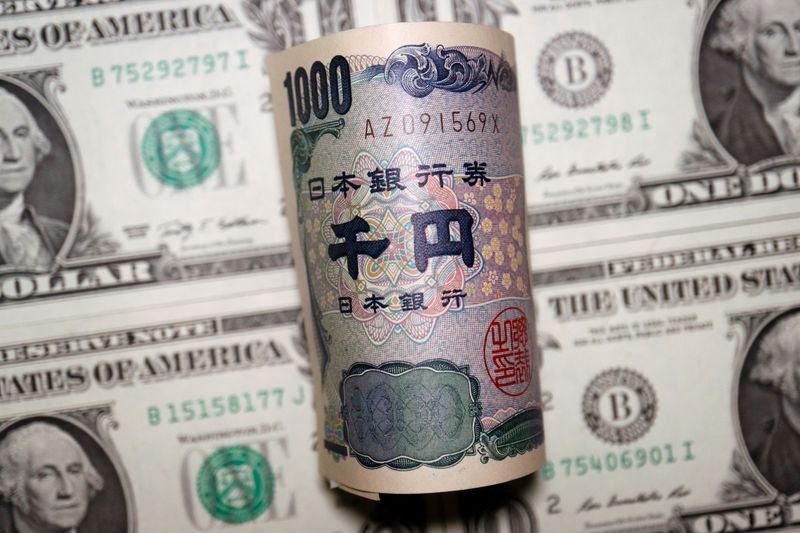
Most Asian currencies rose on Monday as the U.S. dollar extended sharp losses ahead of the Federal Reserve’s policy meeting later this week, while the Japanese yen surged to two-month highs on speculation of coordinated intervention by U.S. and Japanese authorities.
The US Dollar Index fell 0.5% to its lowest since mid-September. US Dollar Index Futures also fell 0.5% as of 06:47 GMT.
Get exclusive insights on emerging forex markets, analyst research with InvestingPro Yen surges amid US-Japan intervention risks The yen’sUSD/JPY pair fell more than 1% to around 154 yen in early Asian trade, after plunging 1.7% on Friday. The moves took the Japanese currency to its strongest level since late November, triggering short covering after weeks of heavy bearish positioning.
Market focus was firmly on intervention risks after U.S. and Japanese officials signaled close communication on foreign exchange developments.
Speculation of joint action intensified after U.S. authorities conducted checks with market participants, a step often interpreted as a prelude to possible intervention, while Japanese officials repeated warnings against excessive currency moves.
The yen’s rally marked a sharp reversal from its recent weakness, which had accelerated following the election of Prime Minister Sanae Takaichi.
Expectations of aggressive fiscal spending and continued accommodative monetary policy under her administration had pressured the currency, pushing it to over 18-month lows earlier in January.
Elsewhere, the South Korean won’s USD/KRW pair fell 0.4%, while the Chinese yuan’s onshore pair USD/CNY edged down 0.1%.
The Singapore dollar’s USD/SGD declined 0.3%, extending sharp losses to hit its lowest since September 2014.
The Indian rupee’s USD/INR edged down 0.2%, but remained near record highs of 92 rupees touched in the previous session.
The Australian dollar’s AUD/USD pair gained 0.3% on Monday.
Dollar under pressure ahead of expected Fed pause The dollar remained under pressure ahead of the Federal Reserve’s two-day meeting, concluding on Wednesday.
Markets widely expect the Fed to keep interest rates unchanged, but investors will closely scrutinize Chair Jerome Powell’s guidance for clues on the timing and pace of potential rate cuts later this year.
"Our house view has been that the Fed will cut rates at the March and June FOMC meetings, but the clear risk is that will be delayed by perhaps three months," ING analysts said in a note.
Traders are also watching for U.S. President Donald Trump’s expected announcement of his nominee for the next Federal Reserve chair. Any signal that the White House could push for a more dovish policy stance has weighed further on the dollar.