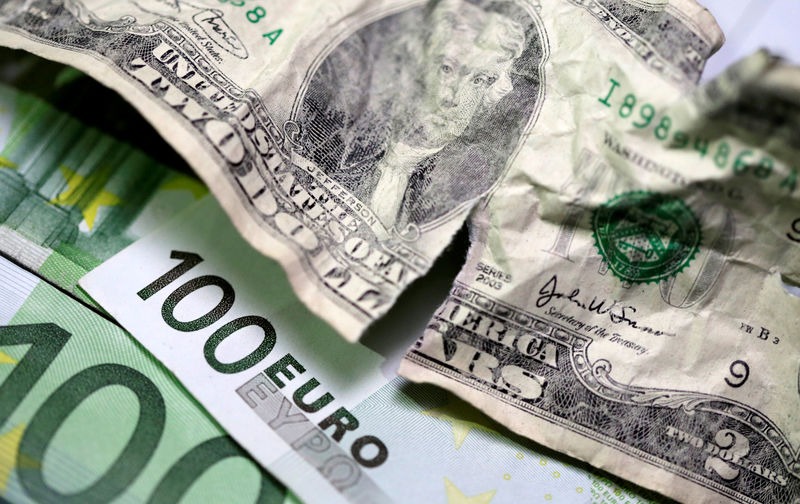
The U.S. dollar fell on Friday, but losses were small and the greenback was headed for its best weekly advance in nearly a month.
The dollar received a major boost a week ago after the nomination of former Federal Reserve Governor Kevin Warsh as the next central bank chief. The move was deemed as hawkish and sparked expectations that Warsh might pursue a shrinking of the balance sheet. The greenback has extended that boost this week.
At 13:51 ET (18:51 GMT), the Dollar Index, which tracks the greenback against a basket of six other currencies, traded 0.2% lower at 97.60. It was set for weekly gains of about 0.6%, its best since early January.
Subscribe to InvestingPro for more analysis - get up to 50% off today Dollar helped by tech stocks selloff
Global shares have seen their biggest weekly selloff since November, as investors fret about the massive spending on artificial intelligence as well as the potential impact AI tools could have on various sectors.
The U.S. dollar has seen the benefit of associated safe haven demand, with the dollar index climbing to levels last seen in the third week of January.
“It’s very difficult to say whether U.S. tech stocks will have another large leg lower. All that can be said is that longer-term, cyclically adjusted price earnings ratios for the S&P 500 are near multi-decade extremes, and the buy-side looks fully invested,” said analysts at ING, in a note.
One of the catalysts for the greenback this week was supposed to be the widely-watched monthly jobs report, originally scheduled for today. It has been delayed until next week, but traders still received several soft labor market indicators this week.
“These have been trying to rebound after April’s big drop. Any surprise dip here could prove a mild dollar negative in that it would serve as a reminder of consumer dependency on stock market performance,” ING added.
Euro, sterling bounce
In Europe, EUR/USD traded 0.4% higher to 1.1820, after the European Central Bank left interest rates unchanged as expected on Thursday.
“At the European Central Bank’s press conference yesterday, President Christine Lagarde made it reasonably clear that the ECB was not on the precipice of cutting rates in response to euro strength,” said ING.
GBP/USD rose 0.6% to 1.3618, recouping some of Thursday’s near 1% slide after the Bank of England also kept rates on hold on Thursday in an unexpectedly narrow vote.
"The BoE’s MPC didn’t cut its Bank Rate today, but its ’dovish’ guidance and close vote split (5-4) points to a cut in March - which has hurt the GBP," Thierry Wizman, global FX & rates strategist at Macquarie, had said yesterday.
"Yet the GBP was being sold before the MPC, on the prospect of a reinvigorated Labour Party leadership challenge to PM Keir Starmer. The risk, as we’ve highlighted before, is that Starmer is replaced by leader (and PM) from Labour’s far Left wing," he said.
"The EUR is all of a sudden looking much better than the GBP, despite its yield disadvantage," Wizman added.
Japanese election on Sunday
In Asia, USD/JPY traded little changed at 157.06, but the pair was trading up around 1.5% this week.
The focus is squarely on the national election for Japan’s lower house on Sunday, with polls suggesting that Prime Minister Sanae Takaichi’s conservative party was set for a strong win.
A greater majority in the lower house gives Takaichi more headroom to enact her fiscally expansionary policies, which entail sweeping tax cuts and more government spending.
Elsewhere, USD/CNY was also little changed at 6.9388. The Chinese yuan was advancing towards its longest weekly winning streak against the dollar in nearly 13 years.
The pair was down about 0.2% against the dollar this week and was headed for an 11th straight week of declines. The yuan was buoyed chiefly by a series of strong midpoint fixes from the People’s Bank.
AUD/USD gained 1.3% to 0.7019 after hawkish-leaning comments from Reserve Bank of Australia Governor Michele Bullock spurred bets on more interest rate hikes by the central bank.
The RBA lifted rates by 25 basis points, and also lifted its growth and inflation forecasts for the year.