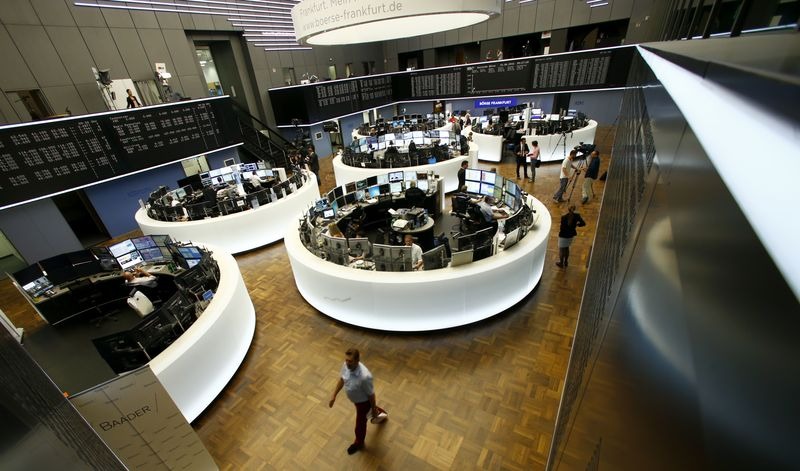
European stocks closed Wednesday’s session mixed after the release of the much-anticipated U.S. employment data.
The pan-European Stoxx 600 gained 0.1%, the DAX in Germany fell 0.4%, and the CAC 40 in France dropped 0.2%. But the FTSE 100 in the U.K. rose 1.1%.
Track European stocks with InvestingPro European earnings wave
Investors were keeping tabs on a bevy of corporate earnings out of the region.
Shares of Ahold Delhaize jumped after the supermarket operator posted fourth-quarter net sales of €23.5 billion, marking a 6.1% increase at constant exchange rates. Comparable sales, excluding fuel, rose 2.5% in the period.
Heineken unveiled up to 6,000 job cuts from its global workforce and guided for lower profit expansion this year compared to 2025, as the brewer grapples with tepid demand. Shares ticked higher after the announcement.
TotalEnergies said it would slash its share buybacks by 62% in the current quarter due to depressed oil and gas prices, although analysts appeared to broadly welcome the group’s cautious approach. Shares rose by 1.4%.
Germany’s Siemens Energy surged by more than 5%. Net profit at the firm almost tripled in the first three months of its fiscal year, buoyed by an artificial intelligence-driven spike in demand for its gas turbines and grid equipment.
In the U.S., shares of Ford Motor inched up in extended hours trading after the carmaker outlined profit and cash flow guidance that was better than analysts’ expectations -- despite taking a $900 million hit from a delay in the effective date of Trump administration tariff relief measures.
Cisco Systems, McDonald’s, and T-Mobile US are also among the headliners on the earnings calendar in the U.S. on Wednesday.
U.S. jobs data in focus
Attention now shifts to a delayed reading of U.S. employment growth, which is due to be released at 08:30 ET.
The figures are projected to show that the U.S. economy added some 66,000 roles in January, up from 50,000 in December.
At its latest monetary policy meeting last month, the Fed described the labor market as “stabilizing” after a recent bout of sluggishness. This argument, combined with signs of steady — albeit elevated — inflation, persuaded the Fed to keep interest rates unchanged at a range of 3.5% to 3.75%.
But White House economic adviser Kevin Hassett warned earlier this week that AI advances could dent U.S. job gains in the coming months, even as productivity is boosted.
The outlook for the current year subsequently remains somewhat murky, given the uncertainty around the trajectory of jobs and prices — the Fed’s two main policy pillars. The upcoming jobs report, along with a fresh consumer price index on Friday, could help bring more clarity around the evolution of rates in 2026.
"[E]quities don’t want to see a collapse in payrolls, but with Corporate America increasingly preaching about efficiencies and productivity enhancements, it’s expected that job creation will remain tepid going forward," analysts at Vital Knowledge said in a note.
Oil prices rise
Oil prices advanced as traders awaited more insight into how relations between the U.S. and Iran will develop, and kept tabs on travel demand during a major upcoming Chinese holiday.
Crude prices recovered from some losses logged on Tuesday, with a subdued dollar, ahead of key U.S. economic prints, also lending support.
Brent oil futures rose 1.6% to $69.92 a barrel, while West Texas Intermediate crude futures gained 1.8% to $65.08 a barrel.
Iranian officials said on Tuesday that nuclear talks with the U.S. allowed Tehran to gauge Washington’s seriousness, and that diplomacy between the two countries was set to continue. This came after the two sides held talks last week over Tehran’s nuclear program, after U.S. President Donald Trump deployed several warships to the Middle East.
While Iran and the U.S. flagged some progress from their weekend dialogue, their comments were overshadowed by the U.S. issuing a warning for ships traveling in the Strait of Hormuz.
Reports also showed Trump considering the deployment of a second aircraft carrier near Iran– a move that could greatly ramp up tensions in the Middle East.
Uncertainty over Iran saw traders price in some risk premium into oil, amid concerns that military action could disrupt oil supplies from Iran.