Futures linked to the major U.S. stock indices edge up, with investors attempting to gauge the outlook for the war in the Middle East. Oil prices hover above $100 a barrel, as U.S. troops reportedly gather in the region and President Donald Trump mulls over a possible operation to extract uranium from Iran. But Trump touts progress in negotiations with Tehran, and suggests a deal to halt hostilities could be coming soon.
Get more market insights with InvestingPro - now 50% off 1. Futures rise
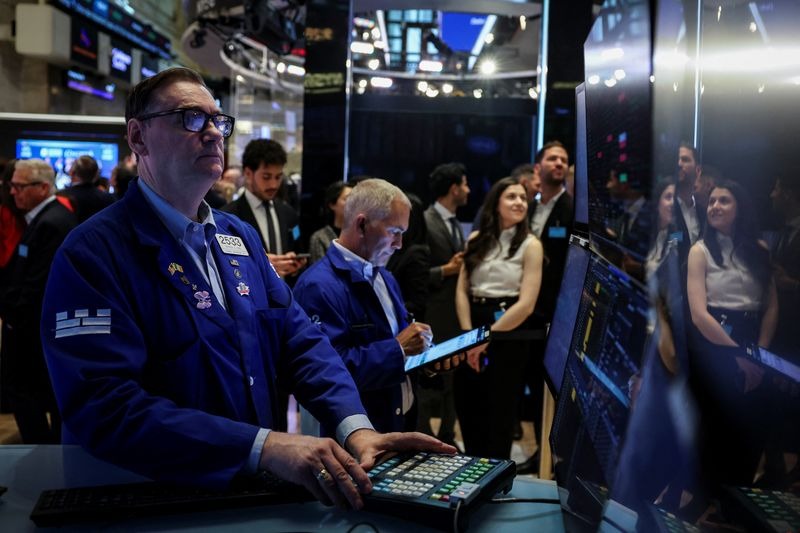
U.S. stock futures pointed higher on Monday, as the war in Iran entered its second month with questions swirling around the trajectory of the widening conflict.
By 03:30 ET (08:30 GMT), the Dow futures contract had risen by 93 points, or 0.2%, S&P 500 futures had climbed by 18 points, or 0.3%, and Nasdaq 100 futures had added 62 points, or 0.3%.
The main averages on Wall Street sank in the prior session, despite President Trump's further extension until April 6 of a deadline for Iran to reopen the Strait of Hormuz or face U.S. military strikes on energy infrastructure.
"[M]arkets remain very much on edge about the Middle East, and the consensus view is still that the conflict is set to escalate," analysts at Vital Knowledge said in a note to clients.
2. Brent climbs
With the conflict in the Middle East raging, the Wall Street Journal has reported that President Donald Trump is considering a potentially complex and risky military operation to remove almost 1,000 pounds of uranium from Iran.
Meanwhile, troops from the U.S. 31st Marine Expeditionary Unit are said to have arrived in the Middle East, in a move reportedly aimed at giving Trump more options as he mulls over the next phase of the war. A Washington Post report said the Pentagon was preparing for weeks of ground operations in Iran.
Tehran has vowed to destroy any U.S. forces that attempt to stage a ground incursion into the country.
At least 12 U.S. troops were injured in an Iranian attacks on an air base in Saudi Arabia over the weekend. Iran-aligned Houthi rebels in Yemen joined the fray for the first time as well, firing attacks at Israel and exacerbating already heightened fears around disruptions to key energy supplies.
Should the Houthis target the Bab al-Mandab Strait in particular, the Vital Knowledge analysts flagged that a global shipping crisis already caused by the effective closure of the Strait of Hormuz off the southern coast of Iran would be "dramatically amplif[ied]." The Bab al-Mandab Strait is a key choke point for vessel traffic which connects the Red Sea to the Gulf of Aden and the Indian Ocean.
Brent crude futures jumped by 3.3% to $108.77 a barrel by 03:45 ET.
3. Trump says Iran negotiations going "well"
Trump suggested that direct negotiations with Iran were ongoing and that a deal with Tehran could be close.
Speaking to reporters aboard Air Force One, Trump said negotiations were going “extremely well,” and that a deal with Iran was possible, touting “regime change” in Tehran after U.S. strikes killed several top Iranian officials in the past month.
“I think we’ll make a deal with them, but it’s possible we won’t,” the president said. Responding to a reporter’s question, Trump said “I do see a deal with Iran, could be soon,” although he did not offer a specific timeline.
Iran has largely denied that direct talks with Washington had taken place since the onset of the war, and has called for a cessation in hostilities before any negotiations can take place.
Yet, as has been the case for much of the conflict, Trump's statements came with caveats. Along with the WSJ report of a potential U.S. uranium extraction plan, the president told the Financial Times that he wants to take Iran's oil and could seize Kharg Island, a major export hub for Tehran.
"Maybe we take Kharg Island, maybe we don’t. We have a lot of options," Trump told the FT.
4. Gold ticks up
Gold prices inched up on Monday after logging wild swings last week. Spot gold rose 0.8% to $4,527.01 an ounce by 03:55 ET, while gold futures rose 0.7% to $4,555.05/oz. Spot gold had fallen as low as $4,000/oz last week before rebounding back to near $4,500/oz by Friday.
OCBC analysts said gold’s rebound from last week’s lows appeared to be largely technical. The yellow metal has recently tumbled as much as 20% from levels prior to the outbreak of the Iran conflict in late February.
They noted that bearish momentum appeared to be showing some signs of easing, with gold’s relative strength index recovering from oversold territory.
But they warned that it was uncertain whether gold’s recovery could be maintained, with key resistance levels for spot gold seen at $4,624/oz, $4,670/oz, and $4,850/oz.
5. U.S. data this week
Investors are gearing up for data this week which could offer some insight into how the war in Iran is impacting the wider U.S. economy.
A fresh gauge of manufacturing sector activity for March from the Institute for Supply Management is due out on Wednesday, with Wall Street analysts predicting that the index will decline but stay in expansionary territory.
Then, on Friday, the latest U.S. jobs report is scheduled to be released. Economists are expecting the U.S. to have added 56,000 roles in March, rebounding from a drop of 92,000 in February. The unemployment rate is also seen holding steady at 4.4%.
The nonfarm payrolls figures will likely be under especially close scrutiny, as they could sway how Federal Reserve policymakers may approach monetary policy in the months ahead.
"In terms of the U.S. data this week, the focus will be on the labor market," analysts at ING said in a note. "Friday's NFP release, [...] should leave the market minded to price [Fed] tightening this year in response to the energy shock. Any surprise weakness could hit the dollar."