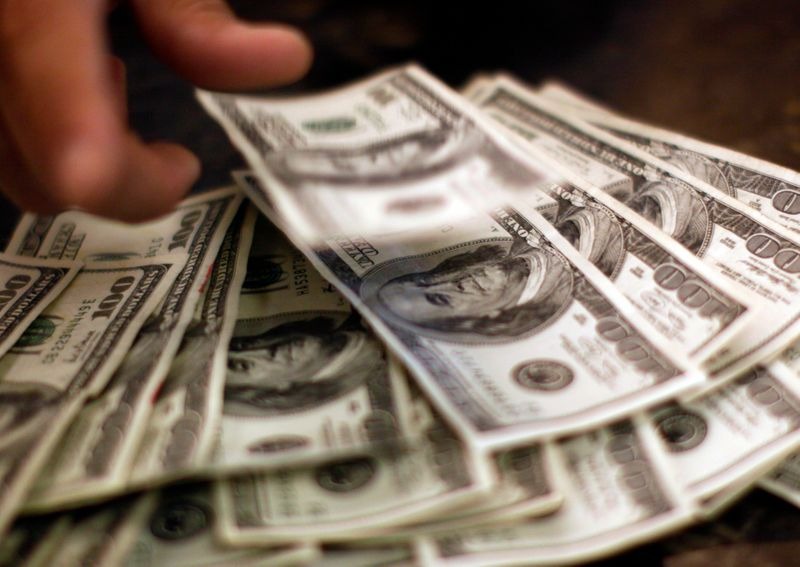
The U.S. dollar strengthened on Friday, putting it on pace for its best month since July, as investors sought safety in the currency amid uncertainty around the trajectory of the Iran war.
At 17:28 ET (21:28 GMT), the US Dollar Index, which tracks the greenback against a basket of six major peers, had ticked up 0.3% to 100.18.
Keep tabs on the U.S. dollar with InvestingPro - now 50% off Dollar heading for best month since July 2025 So far in March, the Dollar Index has risen 2.6%, the biggest monthly increase since an uptick of 3.2% in July last year.
Safe-haven demand for the dollar has been cemented in recent weeks, while expectations of higher-for-longer interest rates due to an energy-induced spike in inflationary pressures have further bolstered the currency’s appeal. Bets that the Federal Reserve, in particular, will cut rates this year have been all but scrubbed out, and wagers that policymakers could raise borrowing costs in the coming months have emerged.
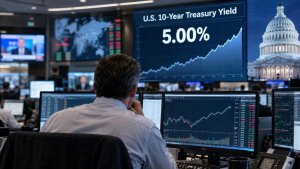
Traders have also responded by dumping bonds, sending U.S. Treasury yields soaring since the start of the conflict. On Friday, the benchmark United States 10-Year yield jumped to its highest level since July.
"The USD has benefited against most major currencies, albeit here too, the effect has been relatively small. Although its easy to attach blame to the ’haven-seeking’ interest of traders and investors for the USD’s tentative rally, we believe that the USD’s strength since February 28 has been more ’fundamental’. It reflects the U.S.’s lesser dependence on imported oil," Thierry Wizman, global FX & rates strategist at Macquarie, said.
"Indeed, the War is a U.S. led effort that has disrupted economic activity globally. But so did the ’Liberation Day’ tariffs of April 2025. But in April 2025 what happened was a USD decline in the face of uncertainty and ’risk,’" he said.
"What’s different today is that the U.S., unlike Europe and the Far East, is unlikely to see a large reduction in aggregate real incomes as a result of the oil price spike alone, although the follow-on distributional implications could be recessionary for the U.S.," Wizman added.
Trump extends key deadline, but Iran says infrastructure hit On Friday, risk assets took a beating as fighting escalated in the Middle East. Oil prices climbed above $110 a barrel, as an extension of a key deadline by President Donald Trump for Iran to reopen the Strait of Hormuz or face U.S. strikes on Iranian energy infrastructure did little to lift spirits.
Iranian foreign minister Abbas Araghchi on Friday said Israel had struck two steel factories, a power plant, and civilian nuclear sites. The minister added that the attacks "contradicted" Trump’s extended timeline.
Trump previously issued an ultimatum to Iran last weekend in which he vowed to strike power plants in the country’s if it did not unblock the Strait of Hormuz, a vital waterway through which roughly one-fifth of the world’s oil flows. Trump later said he would not do so until Friday after what he described as "very strong" discussions with Iran.
Tehran has publicly denied that any such negotiations with Washington are happening.
Euro, sterling lower; Yen hits 160 per dollar Looking at other currencies, the euro EUR/USD slipped 0.2% to 1.1510, while sterling GBP/USD shed 0.5% to 1.3259. Europe continues to grapple with supply disruptions – particularly in natural gas – stemming from the Iran war.
Diplomats from the Group of 7 nations meet in France on Friday, with U.S. Secretary of State Marco Rubio saying the Strait of Hormuz was a key point of discussion. Rubio said any tolling of the strait by Iran would be "unacceptable."
Meanwhile, the Japanese yen weakened against the dollar, with USD/JPY up 0.4% at 160.25. Media reports said the 160 level could trigger a potential intervention from the government. Meanwhile, the Australian dollar, a frequent proxy for risk, was broadly stable after having dipped to a two-month low earlier in the session.
"Our base case remains that the U.S.–Iran conflict is relatively short‑lived and that the geopolitical risk premium eventually fades. However, the risk skew is towards a more prolonged conflict that keeps energy prices elevated for longer," analysts at MUFG said in a note.
"In Asia FX, currencies with the highest energy import dependence remain the most exposed to further escalation in Middle East tensions, most notably KRW and JPY," they added.