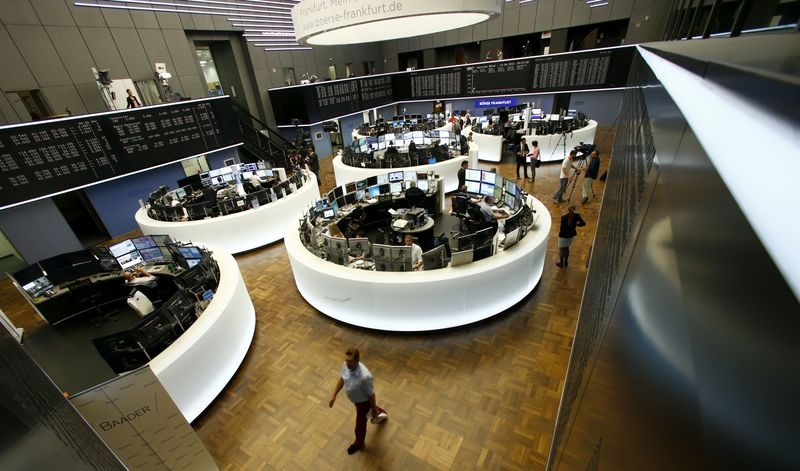
European stocks searched for direction at the open on Monday, while oil prices once again marched higher, as the joint U.S.-Israeli war on Iran stretched into its second month.
Track European stocks with InvestingPro - now 50% off By 03:10 ET (08:10 GMT), the pan-European Stoxx 600 was mostly unchanged, as was the CAC 40 in France. The Dax in Germany had dropped by 0.2% and the FTSE 100 in the United Kingdom had ticked up 0.2%.
With the conflict in the Middle East raging, media reports have suggested that President Donald Trump is considering a potentially complex and risky military operation to remove almost 1,000 pounds of uranium from Iran.
Meanwhile, troops from the U.S. 31st Marine Expeditionary Unit have arrived in the Middle East, in a move reportedly aimed at giving Trump more options as he mulls over the next phase of the war. A Washington Post report said the Pentagon was preparing for weeks of ground operations in Iran.
Tehran, for its part, has vowed to destroy any U.S. forces that attempt to stage a ground incursion into the country.
At least 12 U.S. troops were injured in an Iranian attacks on an air base in Saudi Arabia over the weekend. Houthi rebels in Yemen joined the fray for the first time as well, firing attacks at Israel and exacerbating already heightened fears around disruptions to key energy supplies.
Should the Houthis target the Bab al-Mandab Strait in particular, analysts at Vital Knowledge flagged that a global shipping crisis already caused by the effective closure of the Strait of Hormuz off the southern coast of Iran would be "dramatically amplif[ied]." The Bab al-Mandab Strait is a key choke point for vessel traffic which connects the Red Sea to the Gulf of Aden and the Indian Ocean.
Last week, Trump extended a deadline until April 6 for Iran to unblock the Strait of Hormuz or face U.S. missile strikes on power plants, but investors retained caution as the trajectory of the fighting remained uncertain and murkiness surrounded the conflict’s impact on the global economy. Stocks sank, bond yields edged up, and Brent crude futures -- the global oil benchmark -- continued to hover above $100 a barrel.
On Monday, Brent rose 3.0% to $108.55 a barrel by 03:09 ET.
Although worries have abounded that the jump in Brent could trigger an inflationary cycle that will push governments to react and central banks to raise interest rates, markets do not seem to be "too concerned, yet, about fiscal and inflation risks," according to Thomas Mathews, Head of Markets, Asia Pacific, at Capital Economics.
But, Mathews said in a note, "[t]he war’s effects on markets may continue to elude an easy solve."