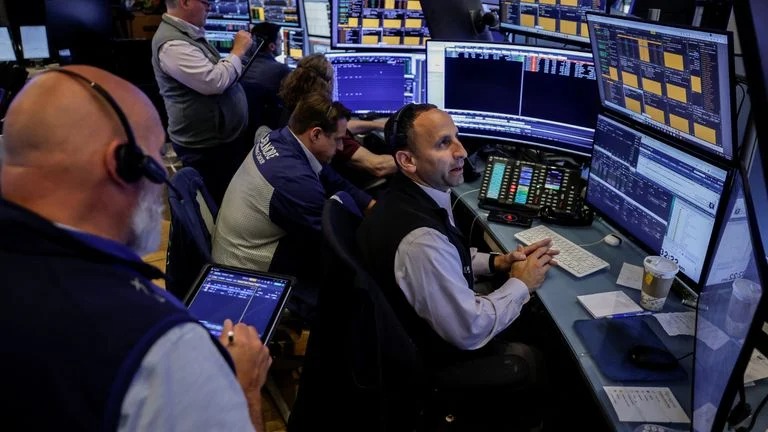
Main U.S. stock indexes were set to open higher on Monday as signs of de-escalating tensions in the Middle East dragged down crude prices, while investors prepared for another week packed with earnings and economic data. Traders also weighed a potential consolidation in the healthcare sector after a report said Bristol Myers Squibb (BMY.N), opens new tab and AstraZeneca (AZN.L), opens new tab held preliminary merger talks. A deal could form one of the world's biggest drugmakers, worth nearly $400 billion.
The U.S. company's shares gained 4.1% in premarket trading, while its UK rival slipped 6.3%. In geopolitics, U.S. President Donald Trump said on Sunday that talks with Iran to reopen the Strait of Hormuz would take place sometime on Monday. Iran, however, contradicted him. Brent crude prices slid 6.6% while the yield on the two-year Treasury note , reflecting short-term interest rate expectations, dipped 5.4 basis points. Higher energy costs since the start of the conflict have fueled uncertainty over repercussions on the global economy. After earnings from Amazon (AMZN.O), opens new tab and Microsoft (MSFT.O), opens new tab last week alleviated some concerns about the lack of evidence that elevated AI spending is paying off, investors will be keen on how other major names fare. "More government debt, increased issuance and persistent inflation have all contributed to a higher cost of capital, leaving earnings as the key driver of returns. We think this trend will continue," Goldman Sachs analysts said. SpaceX (SPCX.O), opens new tab will report on Tuesday its first quarterly results since its public debut, with scrutiny on its AI spending and profits from its Starlink satellite communications network. Its shares, which have been trading below their $135 offering price for nearly three weeks, eased 1.4%. Other AI-linked companies reporting this week include Palantir (PLTR.O), opens new tab, Advanced Micro Devices (AMD.O), opens new tab, and data storage companies SanDisk (SNDK.O), opens new tab and Western Digital (WDC.O), opens new tab. Palantir gained 2.9%, while AMD lost 2.3%; SanDisk and Western Digital lost over 3% each, while software stocks on the Dow such as Salesforce (CRM.N), opens new tab and Microsoft (MSFT.O), opens new tab gained 3% and 2%, respectively.
Micron (MU.O), opens new tab lost 3.9% after Reuters reported that Chinese rival CXMT (688825.SS), opens new tab is considering a second memory-chip plant in Beijing and is in financing talks with a tech manufacturing hub backed by the local government. At 8:38 a.m. ET, Dow E-minis were up 589 points, or 1.12%, and S&P 500 E-minis were up 41 points, or 0.55%. Nasdaq 100 E-minis were up 46.75 points, or 0.16%.
Wall Street had a rough July, bogged down by global concerns about the trajectory of artificial intelligence, future interest rate hikes and a raging conflict in the Middle East. Adding to the uncertainty, Federal Reserve chair Kevin Warsh raised the idea of scheduling fewer rate-setting meetings, a report said — in line with his plan to reduce Fed rate guidance. New York Fed President John Williams said he was optimistic that inflation pressures are on track to ease gradually, Reuters reported. Traders are pricing in a 62.7% chance that the central bank would increase interest rates in September, the CME Group's FedWatch Tool showed.
Hotel operator Marriott International (MAR.O), opens new tab fell 3.9% after forecasting third-quarter profit below expectations, while Tyson Foods (TSN.N), opens new tab dropped 2.5% after cutting its annual profit forecast. The week is also packed with several labor market reports, including the official nonfarm payrolls figures due on Friday. A business activity survey later in the day would give markets a clearer picture about the health of the manufacturing sector during July.